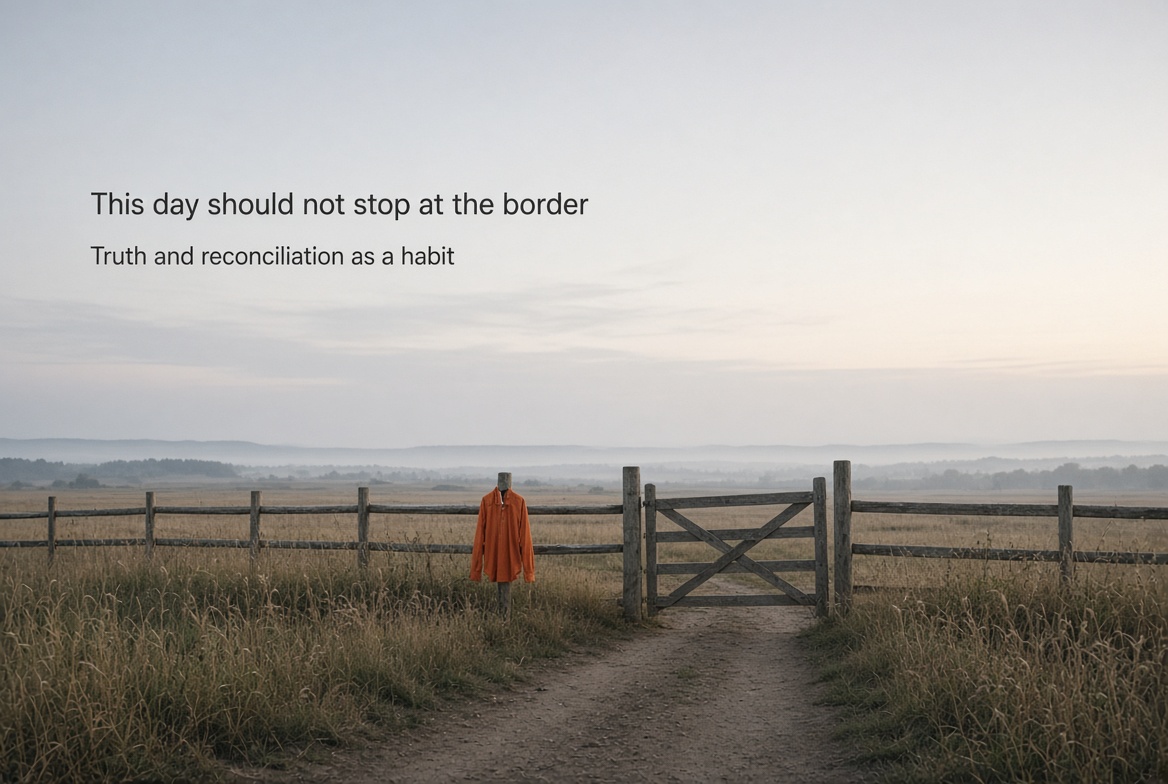
I am Canadian. Today is our day for Truth and Reconciliation, and it should not stop at the border. A friend of fifty years, Harold Thompson, was in Grade 7 in Sioux Lookout in 1962 when his classmates walked off the playground into the swamp. Sixty years later he wrote:
“I hope that reconciliation can include the stories of those that were not survivors but know their stories to be true and their pain and suffering to be real.”
He saw it first. I am trying to say it too.
Today is Canada’s day for Truth and Reconciliation. I support that. The residential schools were wrong. Children were taken from their families, punished for their languages, and too many never came home. That should be remembered without being turned into a performance.
It is also fair, on this day, to look around the world. The same kind of taking happened elsewhere: a child or a people lifted off the land so someone else’s map or language could win. Some of that is finished. We can only learn from it. Some of it is still running. Looking is not changing the subject. It is keeping this day from stopping at the border.
Reconciliation has to have room for the child who walked the swamp and only understood it sixty years later. He is not a survivor. He is a witness who finally learned how to say what he saw.
List 1. What we can only learn from
Canada’s residential schools. Children were taken from First Nations, Inuit, and Métis homes into church and state run schools. Language was punished. Families were broken. Many children died. The country was slow to believe the families who said so.
United States Indian boarding schools. The same system ran here. Hair was cut, names were changed, English only. We are still counting the children and still arguing about whether to call it what it was.
Australia’s Stolen Generations. Children were taken from Aboriginal and Torres Strait Islander families and raised by other people. Many never found their way home.
The Sixties Scoop. After the residential schools closed, child welfare offices kept taking Indigenous children from their families. That taking did not end with the last school. It still happens when protection starts with removal instead of with the aunt and the language.
Sámi and other Arctic minorities. Northern states punished children for speaking their own language in school. The commissions came after the damage.
Switzerland’s Kinder der Landstrasse. Officials took travelling children from their parents and called it help.
Birobidzhan. The state built a Jewish homeland on poor land in the Far East. Then the Jews were driven out or left. The name stayed on the map.
Abkhazia, 1992 to 1993 and after. Most of the Georgian population, about 240,000 people in 1989, was forced out and has not been allowed to return. A smaller Abkhaz nation of about 93,000 bled in that war and then held the ground. Russia uses the result as a buffer. I have friends on both sides. Both things are true.
Soviet punished peoples. Entire peoples were loaded onto trains and dumped far from home: Chechens, Ingush, Crimean Tatars, Volga Germans, Koreans, and others. Many died. Return, when it came, was often to a place already given to someone else.
South Africa’s forced removals. Millions were forced off land and into homelands so cities could stay white. Fathers went to hostels. Children grew up on poor land.
Ethiopia’s resettlement and villagization. Families were moved in a rush from highlands to lowlands. Many died. Villages were regrouped so the government could control them.
Argentina’s disappeared children. The state stole babies from killed or imprisoned parents and gave them new names.
That is twelve. It is only a sample. Other countries ran the same kind of taking. I am not listing them all. Twelve is enough to learn from. The list is still heavy because each line is a child or a people pulled off the land, and because the repair came late or not at all. We cannot undo List 1. We can refuse to run it again.
List 2. Still moving
List 1 is closed. List 2 is still moving. The difference is not time. It is whether anyone is still being taken.
Look for the signs: distance from home as the default, home language treated as a defect on a form, parents who cannot refuse, deaths treated as paperwork, success measured by how little the child still resembles the house.
India, and similar hostels in parts of Malaysia and Indonesia. Large boarding schools still take tribal and Adivasi children far from their villages. The brochure says education and uplift. Children have died in those hostels, some by suicide. Others have run and not all have been found. India is the biggest of these systems still operating.
Iran. School is in Persian. Many Turk, Kurd, Baluch, and Arab children speak another language at home. Before ordinary kindergarten, some now face a Persian language check. If they fail, they can be held back or sent toward special tracks, as if not knowing Persian yet were a disability.
Ukraine. Children have been moved into Russia or occupied territory, put in Russian schools and camps, and given new papers. Tens of thousands of cases have been verified. A fraction have come home.
Gali and the line in Abkhazia. People cannot go home. Children who remain are schooled out of Georgian.
Child welfare. An Indigenous child is still too often removed before anyone funds the relative who already speaks the child’s language.
Measles and Ebola. These are not plagues. They are decisions. Vaccination slipped and the local health teams that used to catch an outbreak in its first week were disbanded, defunded, or never rebuilt. The fire was known. The hose was removed. What follows is bodies, and a people thinned by a choice someone made on paper.
Five acts small enough to start now. Keep school within walking distance of the family that still exists. Pay one elder to keep a language in a room. Kin first, and publish how many children are taken. A clinic day without a sermon. A plot and a tool that put a person back on land.
Some of them had no idea they were Lenin in the wheatfields of Ukraine. They signed requisitions and perhaps had no hope themselves. But they are almost all gone now, and we are still here, and today we have a chance to look at the paper and not sign it. That is enough. If millions do that, we make things better for now.
List 3. People you can copy from this second forward
John Ogonowski, United States. Fourth generation farmer in Dracut, Massachusetts. Captain of American 11. On the morning of September 11, 2001, he was at the controls of the first plane flown into the World Trade Center. He did not choose that. What he chose was the field. He opened White Gate Farm to Cambodian families who had survived the Khmer Rouge. They knew how to grow food. They did not know a New England frost. He lent land, tilled, built greenhouses with his own money, and walked the plots the night before he died to say he would miss their harvest festival. A federal farmer program later took his name. His family kept the field from becoming a golf course. The method is the point: a gate, tools, no conversion.
Colombia. Former FARC commanders and army officers, once on opposite sides of a fifty year war, now work side by side in a cemetery, searching for the disappeared and returning remains to families. The UN calls it an achievement of transitional justice. It is also the same method as Ogonowski: a gate, tools, no conversion. Different field.
The other five: Nicholas Winton, United Kingdom. Chiune Sugihara, Japan, writing visas in Lithuania. André and Magda Trocmé, France. Irena Sendler, Poland. Wangari Maathai, Kenya.
The school systems we remember today also had people who refused them. In Canada: Dr. Peter Henderson Bryce, who put the death rates on paper and published when he was pushed out; Phil Fontaine, who made survivors impossible to ignore; Cindy Blackstock, still fighting the child welfare afterlife of the schools and still laying flowers at Bryce’s grave. In the United States: Zitkála-Šá, who wrote the boarding school from the inside; Deb Haaland, who opened a federal file; survivors now putting their testimony into the Library of Congress. The official story did not print those names. They kept a record, a language, a child, or a lawsuit alive when silence was the job.
Truth and reconciliation is not a holiday. It is a habit: tell the truth about the closed file, then do not put the next child on the bus. If the child is already gone, keep the name. If you have a field, open the gate. If you have friends on both sides of a war, tell neither lie. That is all a Wednesday can hold. From this second forward, it is enough.